
Political Discipleship
It has never been more important for Adventists to refuse to conflate religious identity with political tribe.
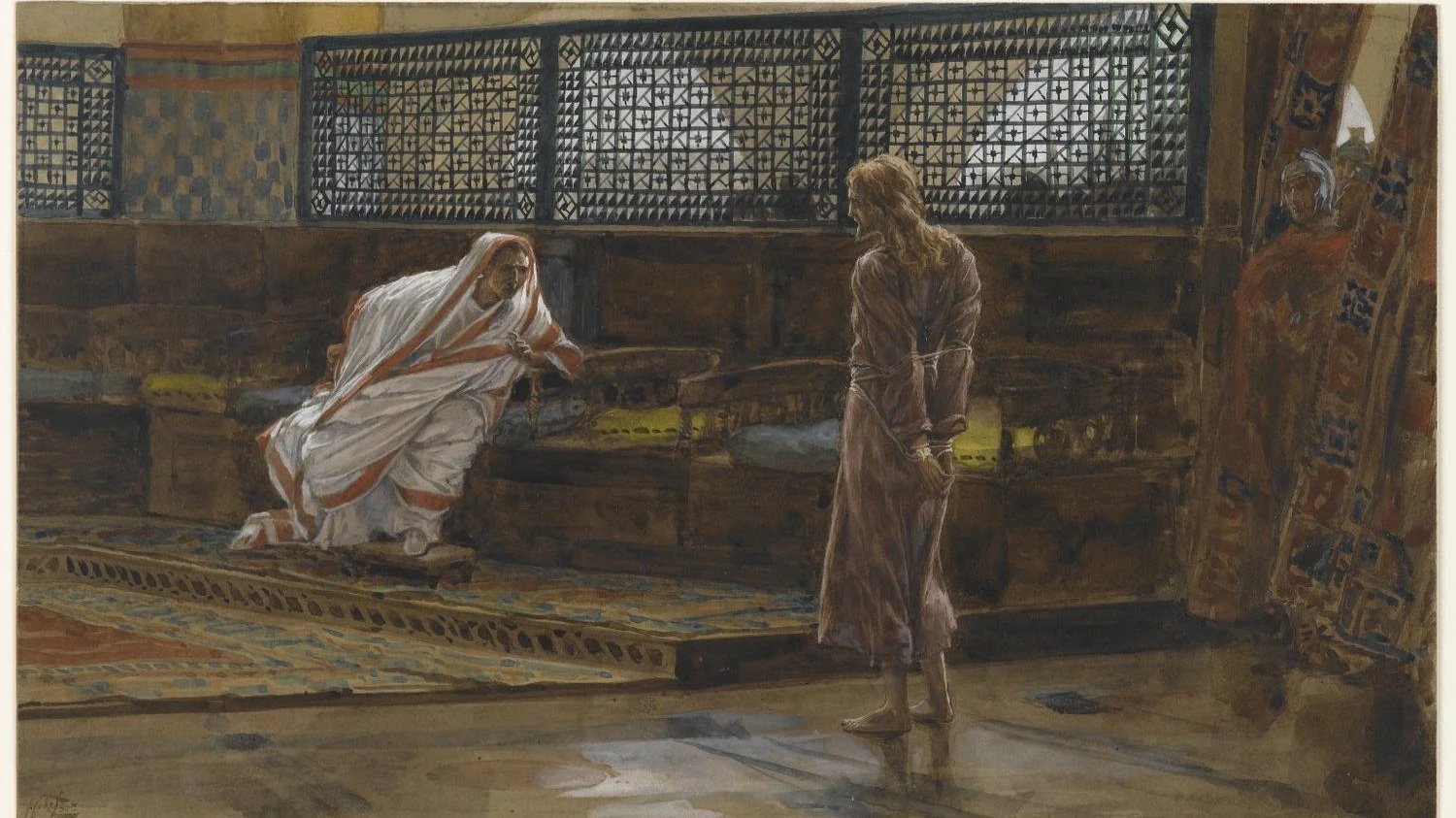
James Tissot, Jesus Before Pilate, First Interview (Photo: Brooklyn Museum)
On a recent Sunday I stood on the National Mall in Washington, D.C., with some 15,000 other Christians from across the United States. They had gathered under a scorching sun to celebrate America’s founding as a “Christian nation” and to renew America’s “covenant with God.”
I was there as a member of the press, representing Liberty magazine, which for the past 120 years has served as a public voice for the Seventh-day Adventist Church, sharing our distinctive understanding of religious freedom and church-state relations. But as I moved through the crowd, I didn’t feel much like a detached observer. Everything felt oddly familiar. I knew the words to the praise songs performed throughout the day by a succession of high-profile Christian artists. I chatted with friendly groups of people—whole families, from grandparents to toddlers, and church groups wearing matching T-shirts, who had traveled from as far away as Alaska and Texas to be part of what they believed was a historic moment.
As the day grew hotter, so did the rhetoric from the stage. Politicians, cabinet members, megachurch pastors, and political commentators denounced secularism, godlessness, and the political left, and called on Christians to “take back our country for God.”
Toward late afternoon, President Trump appeared via video on giant screens reading from 2 Chronicles 7:11–22. Immediately afterward, two self-styled prophets associated with the New Apostolic Reformation—a fast-growing and influential Charismatic movement—took the stage and exhorted the crowd: “What we have just heard was a clarion call from our president for a covenant renewal and outpouring. Brothers and sisters, this is a hinge moment in history.” Across the Mall, thousands dropped to their knees and raised their arms toward heaven.
In the Image of the Algorithm
For those who follow developments at the intersection of politics, faith, and eschatology, the Rededicate 250 event in Washington wasn’t particularly surprising. It was another public expression of movements that have been gathering momentum beneath the surface of American life for decades—dominionism, Catholic integralism, post-liberalism, and Christian nationalism. Our congregations aren’t insulated from these forces. When it comes to questions of faithful citizenship, most church members aren’t being discipled by their pastors, their Sabbath School class, or their prayer group. They’re being discipled by podcasts, YouTube personalities, and partisan media ecosystems. Day after day, they’re absorbing messages that teach them—implicitly or explicitly—that Christ’s kingdom is of this world.
As editor of Liberty magazine, I hear from readers who are deeply troubled by the cultural shifts around them and who, for want of a better term, have become politically radicalized. And for some, a natural love of country has evolved into the belief that their nation occupies a uniquely favored place in God’s purposes and that Christians have been called not primarily to spiritual witness, but to political conquest.
I also hear from pastors, exhausted by the constant red–blue tensions within their churches, who feel as though they’re walking a tightrope, especially during election seasons. As one pastor told me, “Since COVID, I can’t preach about any topic that might remotely be interpreted as political.”
For more than 160 years, Seventh-day Adventists have offered a distinctive witness in matters of church and state—not withdrawing from public life but refusing to conflate religious identity with political tribe. But if that witness is going to endure, we can’t simply assume that our members understand and embrace it just because it’s part of our denominational history.
As leaders, we’re also vulnerable. Regardless of whether our personal political convictions lean left or right, we’re all susceptible to self-blindness. All of us, at times, can unconsciously confuse “thus saith the Lord” with the talking points of our preferred political party, and the line between prophetic preaching and political endorsement can become harder for us to see. Yet for pastors and leaders, the stakes are especially high. When we fail to discern that line clearly, the consequences can be devastating for the communities we serve.
Standing on the National Mall that afternoon, I understood why so many sincere Christians are drawn to promises of national renewal through political power. But I also left convinced that it has never been more important for Adventists to clearly understand and faithfully preach our prophetic perspective on religious freedom, conscience, and citizenship. In an age of political discipleship, we need a renewed vision of what it means to belong first to the kingdom of God.
A Resource for Pastors and Church Leaders
Liberty magazine’s mission is not only to reach judges, lawmakers, and community leaders across North America, but also to serve as a resource for Adventist pastors and church leaders. We’ve recently developed a free digital edition of Liberty specifically for NAD pastors. Delivered bi-monthly by email, it offers articles, analysis, historical perspective, and practical reflection on religious freedom, politics, and faithful Christian citizenship in a polarized age.
If you would like to receive this free digital resource, you can subscribe here. Or, if you prefer the print edition of Liberty, simply email your name and mailing address to editor@libertymagazine.org. We are happy to provide NAD pastors with a complimentary one-year print subscription.