
Small Resurrections
Muslims are drawn by blessing and moved by the power of a story.
The First Barrier: A Church
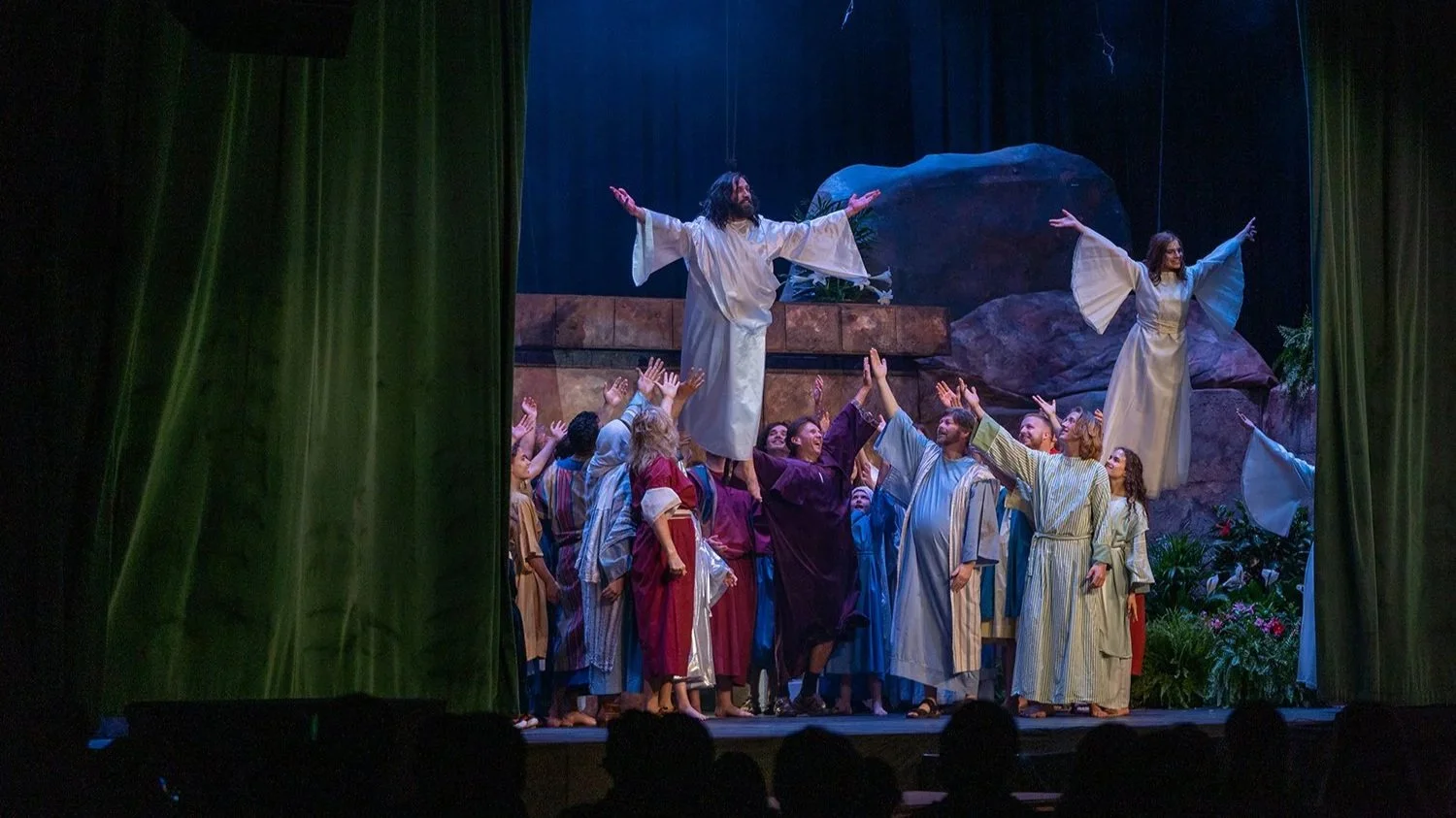
The room is dark, lit only by candles, while a deep and heavy voice bridges the gap through the ages, summoning us back to the Last Supper and the final scenes of the Passion Week. Next to me in a large pew are Mohammad and Khadija, Muslim refugees from Iraq. Most Muslims have a strong emotional barrier when it comes to entering a church; centuries of images associated with idolatry and misused power, blended with strangeness, make this real. However, Mohammad and Khadija are not strangers, but beloved neighbors who know that the Abrahamic vocation to be a blessing to each other is core to us.
From the shadows comes a young Southern University student embodying Mary Magdalene; her Jesus is not a detached preacher of truth, but one who has dust under his fingers. This Jesus bends down to save lives, and with otherworldly authority, still says, “Let those who are free from sin cast the first stone.”
The play is beautiful; several rapidly overlapping scenes are on display, all centered on Jesus amidst chaos, yet the words of Jesus are the ones echoing in Khadija’s heart.
As we left the church on our way to the rest of the stations representing the stages of the Passion Week, Khadija held my hand and said, “We all need to repeat and live by the words of Isa, alayhi salam [Jesus, peace be upon him].”
And for the next few minutes, she did what every follower of Jesus should: she imagined a world ruled by this law and authority, a world free of stones, where sins can be erased in the sand, and where women could taste the fruit of the Tree of Life from the words of Isa. This is a moment of beauty, of redemption, where the heart and mind enter a state of improvised worship, and we both feel drawn to Him.
The Second Question: The Trinity
Mohammad’s response was different, yet no less profound. At the scene when Jesus is pleading in Gethsemane, he asks, “Who is Jesus praying to?”
Underneath that question, there are layers of theological debris, from centuries of Christian-Muslim misunderstandings. This question goes to the heart of the second most debated issue between us, the Trinity and the divinity of Christ: “Who is Jesus praying to?”
I could have engaged in a lengthy explanation of theology, but I know this is a sacred moment. The Holy Spirit is at work in every scene, and it is not the time to interrupt the flow. Later, we can unpack it further, so I said, “Jesus is praying to his beloved Father. He is praying to God.”
“So, he is not praying to himself?” he added.
“No,” I said. “He is in communion with God and asking for all those who one day would follow him. He is thinking of us all.”
The Third Landmine: The Cross
Over the years, I have learned that truth that is not aesthetic and relational seldom moves the heart to discipleship. Now, we arrive at the cross. This is a third landmine for Muslims, who live in an alternative story in which Jesus does not die but instead is rescued by God, who makes Judas look like Jesus and they get swapped. In this version, justice is preserved: Judas gets punished, and Jesus’ innocence is vindicated.
The problem with this story is that it destroys the heart of God’s plan of redemption. It subverts the scandal of the cross because it is ultimately rooted in the sovereignty and power of God, instead of his love and desire to preserve freedom, mercy, and justice under the banner of his love. We move slowly. Khadija is among the crowd moving along with other dear Adventist friends, while Mohammad and I walk solemnly. I am praying silently for him and for me, and for the guidance of the Holy Spirit that I may not miss encountering God’s voice afresh under the guise of familiarity and pride.
Now, we are standing under the court of Pilate. God sent a dream to his wife, and Mohammad gets it. In his world, dreams are gates to heaven. He hears the voices of Jews calling for Jesus to be crucified and is confused. Why would anyone wish to crucify Jesus, who is the purest of prophets? He then correlated this to today’s events in the Middle East and the need to bring Jesus’ example back. I wish he had elaborated on what about Jesus’s example needed to be brought back. But the scenes were moving, and I did not want to miss the cross.
Now we are standing in front of three crosses. He remembers the many times he had seen dead people in Iraq. War is a terrible thing. One minute a person is alive, the next, he is left lifeless in front of you. Violence, shouts, blood—this is real now in a way that I have never experienced before. What will the cross say to this world? Jesus understands. This is divine solidarity. Now, I have to explain the logic of the cross very briefly. After all, three men are hanging on crosses. What makes Jesus’ death different? This is a precious moment.
“In Jannah [paradise], God gave Adam and his wife everything for life and life abundant because he loved them. He also explained to them that life would flow as long as they did not open the door to sin because the consequence of sin is death. This is the law of the universe. God brings life; walking away from life brings death, just like turning off the light brings darkness. Since every person has sinned, they all will die one day. Death has power over all who have sinned, except Jesus, who was sinless (which is also mentioned in the Qurʾan), so the only way death could touch Jesus was if he would give up his life. And this is why the Qurʾan agrees with the Bible when it says that the Jews did not ‘kill nor crucify him, but it seems to them …’ (Nisa 4:157).”
A massive stone needed to be removed so that Mohammad could see that the resurrection is real and not simply a translation into heaven, as Muslims believe. Mohammad was silent. Jesus was in front of us, and with all my heart, I was asking him to speak afresh to us. Mohammad said that the cross represents the severity of God’s power. He is Rahman (the Most Merciful), but his mercy is so severe that it could kill; that’s why, whenever the name of God, Rahman, is used, it needs to be used alongside Rahim, which represents his compassion. This description of God is not natural to me, but I realize two stories are colliding, and God’s Spirit needs to be the corrective guide.
The Resurrection
Now, we move to the last scene, “Arise my Lord.” Tears are flowing freely and warmly as I taste the music. Jesus is risen! Mohammad is next to me sensing the power of the moment, when I add, “Brother, this is the heart of my faith, that Jesus chose to die, to carry the sins of each sinner, that he was raised back to the right hand of God to rule with love, and that he will return to heal all that sin destroyed and remove Satan.”
Mohammad is also moved by the power of the story, not to tears, but by the possibilities that this story brings for peace, and like his wife, he paints with words, pregnant with hope, a world where followers of Jesus will follow him and stone neither each other nor those who are not from their own group. And then he surprised me when he said, “We Muslims need to return to Jesus, not the Jesus of Islamic scholars and traditions, but the real Jesus. We keep telling the Christians with our mouths that we also love Jesus, that he is one of our prophets, while collecting stones with our hands. We need to listen again to Jesus; he is peace.”
Dr. Gabriela Phillips is the NAD Director for Adventist Mission and has over 25 years of experience in Adventist-Muslim relations.