
Review of A Global History of Seventh-day Adventists
This book marks the clearest step yet toward a genuinely multi-centered account of the church.
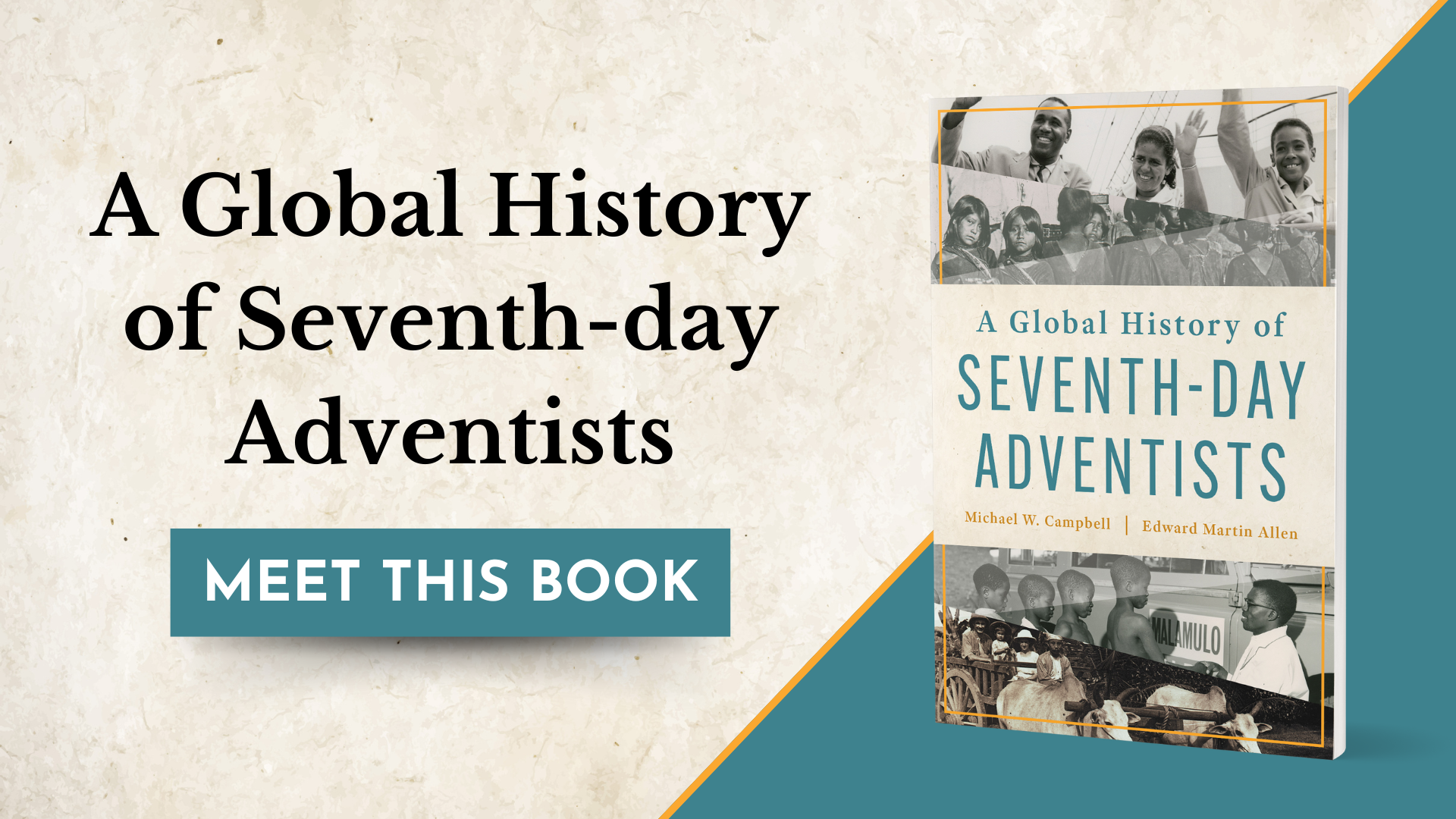
Used with author’s permission
For more than a century, the majority of Seventh-day Adventists have lived outside the United States. Yet much of our historical writing has continued to orbit its American origins.
In A Global History of Seventh-day Adventists, Michael W. Campbell and Ed Allen—both former missionaries—attempt to reframe the story accordingly. Compressing a diverse, worldwide church into a volume roughly half the length of earlier surveys, they offer an ambitious and often compelling synthesis.
Published by Eerdmans on February 12, 2026, and endorsed by prominent Adventist and evangelical historians like Mark Noll, David Bebbington, and George R. Knight, A Global History not only narrates an international story but does so for an interdenominational readership.
Context And Content
A Global History is a historical synthesis; that is, a narrative fashioned from the craft of a variety of historians, including Campbell and Allen. As a synthesis, it keeps company with George R. Knight’s Adventist Heritage Series (1999–2000) as well as the revised edition of Light Bearers (2000). Alongside these peers, A Global History is both the most ambitious and concise.
The authors immediately challenge the North American reader’s understanding of the Adventist church today: “The predominant population of the church has shifted to Africa, and the intellectual center may be moving to South America” (1). A “global” history is therefore not just one possible approach towards Adventist history but the only way. A Global History thus coaxes ‘Western’ readers to reckon with the reality that the church’s momentum and growth are now decisively located outside its historic North American, Australian, and Western European heartlands.
The narrative proceeds in a largely chronological fashion until 1863, when the storyline branches. Subsequent chapters revisit overlapping periods from thematic angles: theology and mission, education and health, organization and expansion. A similar structural split occurs in the treatment of the so-called “golden era” of missions and the consolidation of church organization.
After the death of Ellen White, the narrative moves through the two world wars, Adventist fundamentalism, and the church’s uneasy proximity to nationalist movements, including its entanglements with Nazi Germany—ironically treated in a chapter titled “Movements Toward Unity.” The postwar period receives its own chapter, followed by thematic treatments of theological development and demographic transformation in the late twentieth and early twenty-first centuries. A concluding chapter carries the story to 2025, though necessarily without the benefit of historical distance. Each chapter concludes with review questions designed for classroom or small-group discussion.
Why This Book Matters
A Global History is the first major synthesis of Adventist history in the twenty-first century. In recent years, Adventist scholars have produced a wealth of specialized research—biographies, regional studies, and theological analyses. Campbell and Allen gather this scattered scholarship and distill it into a single accessible volume. They collect the honey of many combs and present it in one jar.
The narrative reach of A Global History is also impressive. Unlike earlier surveys that centered primarily on institutional and theological milestones, A Global History deliberately expands the lens. It explores cultural expressions (from snack cakes to music), public controversies (including recent lawsuits), and global reception. This broader approach yields a more textured portrait of Adventism, even if it inevitably leaves some subjects briefly sketched.
Written in and for a more visual age, A Global History features photos and figures (nearly 100 by my count) as a means of engaging more deeply with the story. A section on the fundamentalist–modernist controversy (pages 150–151) shows a spread of anti-modernist cartoons. A previously unpublished photo of Robert Brinsmead (p. 225) in the Philippines reminds us that the “global history” of this book is visual as well as textual.
Challenges
The book’s brevity, however, imposes real constraints. Most critiques will likely concern the distribution of space. Reasonable readers can debate whether the American Civil War deserves as much attention as the founding of AIIAS. More troubling, however, is the treatment of Adventist involvement in the Rwandan genocide, which appears in a single sentence within a broader warning about nationalism. Given the moral gravity of that episode, this feels like a missed opportunity to bring readers face-to-face with one of the darkest chapters in Adventist history.
The book also exhibits a sharper political realism than earlier surveys. Campbell and Allen note, for example, that while the White Estate identified factual errors in Ronald Numbers’ Prophetess of Health, it did not directly address his central argument. Such frankness will commend the volume to some readers and unsettle others accustomed to more protective historiography.
At times, however, gestures toward complexity are not fully developed. We are told that there are concerns about Africa’s rapid growth. One concern is that “the emigration of many white South Africans has left a void that is hard to fill” and that the end of segregated conferences there has “brought some turmoil.” Unfortunately, the reader is left to guess at what this means and whether all African Adventists share this concern.
Conclusion
A Global History is the most important Adventist history of this century for at least three reasons. First, it makes clear that Adventism is a mature, global faith and can only be grasped when understood as such. Second, it synthesizes a remarkable body of recent scholarship and makes it accessible to a broad readership. Third, its concision and use of visual media give it the best opportunity to shape how Adventists understand their past in the decades ahead.
If Adventism now lives in many centers rather than one, then its histories can no longer orbit a single Western axis. A Global History marks the clearest step yet toward a genuinely multi-centered account of the church. The structure is not finished, but the foundation has been laid.
Matthew Lucio pastored for 15 years before his current role as Assistant to the President for Communication in the Illinois Conference and is the director of the Adventist History Project.